
By Sophia Benavente, Law and Policy Intern, Im/migrant Well-Being Scholar Collaborative
August 2026
INTRODUCTION
President Trump’s second administration has been marked by sweeping changes in immigration enforcement, which have impacted the lives of immigrants and their families. Data from the Deportation Data Project reveal that between February 2025 and March 2026, Immigration and Customs Enforcement (ICE) detained over 6,200 children. Recent investigations, including one from The Marshall Project, detail children and their families being kept in inhumane conditions in detention centers with mold, insects, and poor food and water quality.
However, these detention practices and their conditions are not new and have long faced legal challenges. The legal foundation governing how the U.S. government must treat migrant children in detention dates back nearly four decades, to a landmark case known as Reno v. Flores.
What is Reno v. Flores? Why is it important for well-being?
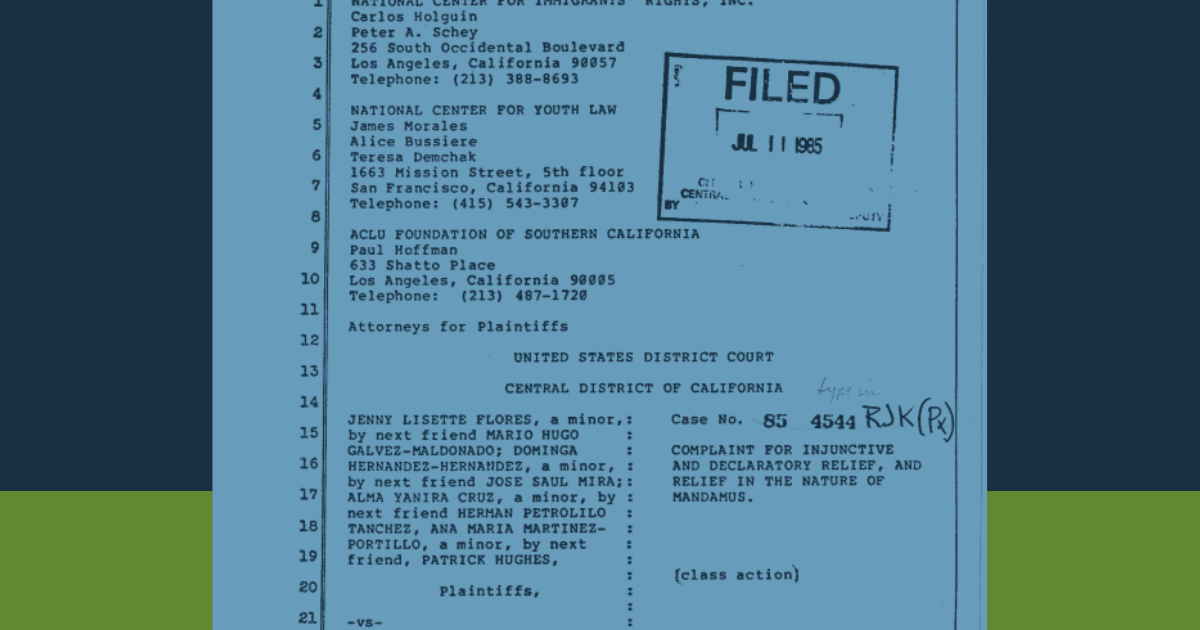
In 1985, the American Civil Liberties Union (ACLU) went to court on behalf of Jenny Flores, a minor fleeing the Civil War in El Salvador, who was detained, subjected to a strip search, and held in a makeshift facility in California. She was held in a juvenile facility for months with no education, recreation, or other support while she awaited deportation.
The case ultimately reached the Supreme Court, ending in 1997 with the Flores Settlement Agreement, a consent decree which established national standards for the detention, treatment, and release of minors in immigration custody. The key provisions of the agreement include:
Minors must be released without unnecessary delay to a parent, family member, or other appropriate caregiver.
Children must not be held for prolonged or indefinite periods in immigration prisons or detention facilities.
When detained, the U.S. government must provide safe conditions and basic necessities, including showers, clothing, water, and food.
Implications and Developments
The Flores Settlement Agreement has faced several legal challenges since 1997.
One of the most significant developments came in 2016, when Jenny Flores returned to court, bringing action against ICE for its practice of detaining accompanied minors in secure, unlicensed facilities in direct violation of the settlement. The Ninth Circuit sided with Flores, arguing that the Flores Settlement Agreement unambiguously applies to both accompanied and unaccompanied minors. This was a major expansion of the agreement’s reach, as the government had long argued that children who arrived with a parent were not covered.
The first Trump administration attempted to issue new federal regulations in 2019 through the Department of Homeland Security (DHS) and Health and Human Services (HHS) that it claimed satisfied and would replace the Flores Settlement Agreement. However, attorneys representing a group of immigrant minors argued the regulations did not implement the agreement and circumvented and undermined its key provisions. The United States Court of Appeals for the Ninth Circuit upheld that ruling in 2020.
The agreement was tested again during the COVID-19 pandemic under Title 42, but the Ninth Circuit affirmed a court order requiring DHS to apply the 1997 Settlement Agreement to minors detained in hotels for more than a few days while being expelled. The ruling made clear that the government cannot evade its obligations by using non-traditional or makeshift detention settings.
The Government’s Push to Terminate Flores
On May 22, 2025, the Trump administration filed a motion to terminate the Flores Settlement Agreement entirely. In its filing before Judge Dolly Gee in Los Angeles, the Justice Department argued the settlement should be “completely terminated”, claiming it has limited the executive branch’s ability to set immigration policy and has encouraged illegal border crossings by migrants’ families and unaccompanied minors. The Department of Justice (DOJ), joined by DHS and HHS, further argued the agreement is outdated and unworkable. In August 2025, the district court denied the administration’s request to terminate the settlement. The government appealed, and by December 2025, the case had moved to the Ninth Circuit Court of Appeals, with a decision in the case pending following oral arguments on June 2, 2026.
Growing Opposition
The Young Center and partner organizations filed an amicus brief in January 2026 urging the Ninth Circuit to deny the government’s motion, arguing that Flores Settlement Agreement safeguards remain essential to the well-being and legal rights of children in immigration custody. They are not alone. California Attorney General Rob Bonta led a coalition of 20 state attorneys general in filing a separate amicus brief, urging the Ninth Circuit to block the administration’s attempt to end the agreement and prevent the prolonged and unnecessary detention of children.
Opposition has also come from child welfare experts and advocates who warn that terminating the agreement would have both short- and long-term consequences. Flores counsel argues that ending the settlement would inflict lasting trauma on children in federal custody by removing vital safeguards for their health and safety and putting them at risk of indefinite detention.
What’s Next?
The Flores Settlement Agreement has endured for nearly three decades because courts have repeatedly recognized that children in government custody require enforceable protections. Whether the Ninth Circuit upholds those protections will be one of the most consequential immigration decisions of 2026 and will have a direct impact on the safety and well-being of children.