
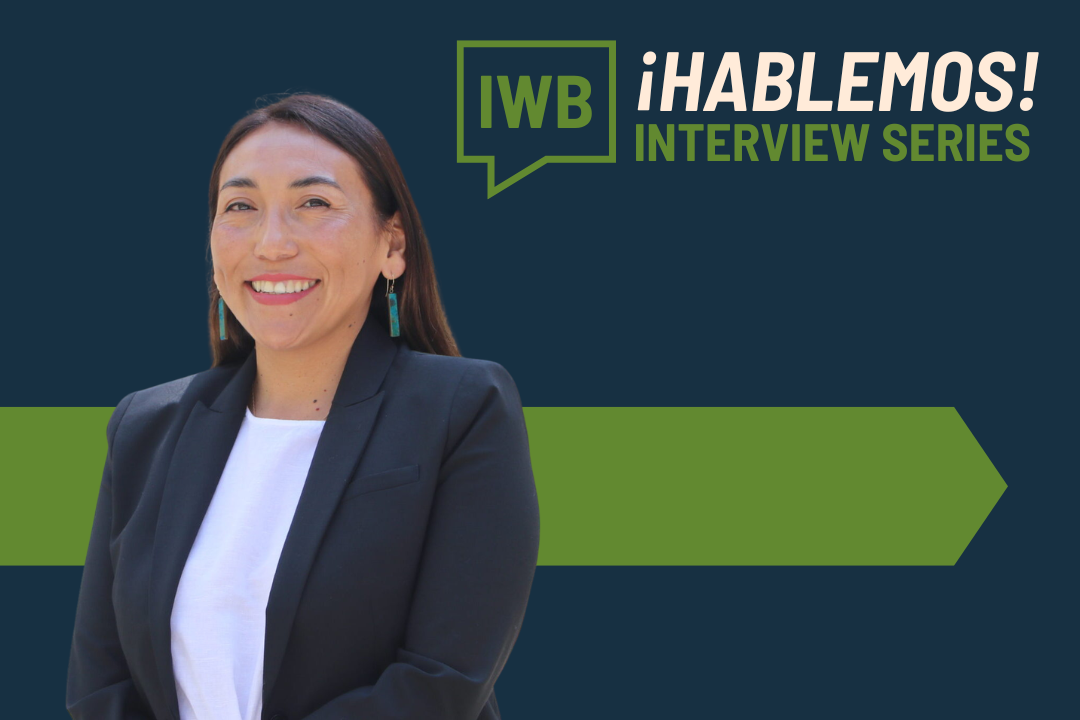
By Sophia Benavente
Sophia Benavente from the Collaborative sat down with Dr. Martinez-Aranda in March 2026 to discuss her professional journey, as well as her research and its broader implications. Dr. Mirian G. Martinez-Aranda is an Assistant Professor of Sociology at the University of California, Irvine. Her academic work focuses on immigration detention, surveillance, law and society, and race and ethnicity. Her research has been published in well-regarded academic journals such as Social Problems, American Behavioral Scientist, Journal of Ethnic and Migration Studies, and Law & Society Review.
Academic Roots
Dr. Martinez-Aranda traces her career back to her undergraduate studies at UC Berkeley, where she took courses that contributed to building her foundational knowledge on immigration, but also notes her personal connection to the topic as an immigrant herself. As a graduate student at UCLA pursuing her PhD in sociology, she began volunteering with Freedom for Immigrants, a community organization that supports people held in immigration detention. While helping those who were detained navigate the immigration system to secure their release and communicate with their families, she noticed that right after many people were released from detention, they were leaving with an electronic monitor.
Though the United States government describes electronic monitoring as a humane alternative to detention, Dr. Martinez-Aranda saw it for what it really was: an extended form of punishment. The monitors were hindering immigrants’ ability to work or spend time with their families in certain areas, effectively truncating their community reintegration. Surveillance and control spilled outside of their detention affecting their families and larger communities.
Connecting with the Im/migrant Community in Southern California
Being embedded in the Southern California community has allowed Dr. Martinez-Aranda to ask rich and complex questions within the vibrant and diverse immigrant community there. However, these very characteristics are what also make it a hotspot for ICE enforcement and a sought-after location for detention infrastructure. Nonetheless, she has witnessed community organizations that are pushing back against unjust laws and policies.
In her work, “Weaponized waiting: how an administrative burden harms families visiting loved ones in immigration detention,” she introduces the concept of “weaponized waiting,” which emerged from listening to the families in Southern California impacted by immigration detention. The more she listened, she understood that they were not experiencing just a waiting period, but one that was saturated with anxiety, fear, and uncertainty.
Dr. Martinez-Aranda witnessed what families were experiencing while waiting to see their loved ones who had been detained, illustrating the opaque policies that were being employed, such as unauthorized transfers of their loved ones, or shifting visitation schedules that nobody could explain. At the micro level, she witnessed harmful and petty administrative decisions that affected those who were detained, such as withholding information from immigrants or denying them access to the bathroom.
In 2024, working with the Collaborative, Dr. Martinez-Aranda co-authored The Impact of ICE Surveillance Technology on the Well-being of the Children of Immigrants about the effects of Immigration and Customs Enforcement (ICE) surveillance on the well-being of immigrants and their children. Since its publication, she has seen how the current presidential administration has expanded the number of people shackled to electronic monitors as it is being deployed as a mass management and surveillance tool.
When asked about her experience with the Collaborative, Dr. Martinez-Aranda remarks that, as a first-generation Latina in academia, she appreciates spaces that allow her to connect with like-minded scholars. Through the Collaborative, she has been able to build meaningful connections that later turn into relationships that advance well-being.
She also finds it valuable to learn how to translate her research into actionable policy change. She shared that she appreciates how the Collaborative team and network of scholar affiliates champion a model that teaches scholars how to connect scholarly research to the lived realities and experiences of immigrants and their families.
She has also observed how immigration enforcement has moved into protected spaces, such as schools, churches, and even homes, leading immigrants to fear sending their children to school, seek medical care, or report crimes. Recently, Dr. Martinez-Aranda participated in a training hosted by the Collaborative, which explored researcher safety best practices for navigating sensitive research.
Embarking on her First Book
Dr. Martinez-Aranda’s upcoming book focuses on the experiences of families in the aftermath of immigration detention. When immigrants are released, they come home with chronic stress, which festers as the threat of detention continues. This stress is transferred to their children, who might have already developed anxiety and depression if their parent had been detained. Some of these children may have experienced the moment when their loved one was apprehended, or they may have had to take on adult roles in their absence.
She encourages scholars to research and record the effects of heightened immigration enforcement and detention on children. One of the underreported consequences that children are facing is how their parents grow afraid to engage with social institutions, such as schools, healthcare agencies and practitioners, and local law enforcement.
Sadly, she says, much of current immigration policy is dominated by harmful rhetoric about immigrants, which is why she sees sociology as so important. Sociology pushes beyond that rhetoric to reveal political, legal, and institutional forces that shape immigrants’ lives.
Bringing empirical evidence into policy debates, Martinez-Aranda’s research on “weaponized waiting,” for example, shows how immigration policies inflict psychological, emotional, and social harm on families. Sociology exposes the gap between what immigration policies claim to achieve and how they actually affect people, making the field central to some of the most important conversations about immigration today.
The Punishment of Immigration Detention Extends Far Beyond Individuals
Dr. Martinez-Aranda wants people to take away from her work that detention not only punishes individuals but also impacts entire families and broader communities. Many of those who are detained are people who have done nothing wrong. Dr. Martinez-Aranda’s research has found that the system is designed to harm people and keep them vulnerable in fear and uncertainty. The families she has spent years with have names and stories; they are real people. Their stories deserve to be heard.
Another key takeaway she wants people to understand from her research is that behind every policy debate, there are families that are being separated and children that are being traumatized. What is currently happening in immigration policy debates are not abstract policy outcomes, but rather about human beings whose lives are being impacted every day. As she said, “Detention doesn’t just punish individuals. It punishes entire families and communities.” The responsible thing to do is not reform it into something that appears more humane – but to abolish it and consider a new way forward.
Despite the challenging nature of her work, Dr. Martinez-Aranda finds hope in the next generation. She teaches a class about immigration detention through an abolitionist perspective, examining how today’s punitive systems, including immigration detention, are historically rooted in the dispossession of Indigenous land and the enslavement of Black people.
In her classes, she has had conversations with students who are truly committed to creating a humane and fair system. She also finds herself pivoting to understanding how people in communities are becoming trained to represent themselves in immigration courts, or how to support other community members going through the process. She finds hope in how people themselves are overcoming systemic barriers to achieve justice.
Thank you for reading IWB ¡Hablemos!, an interview series that explores the multifaceted nature of immigration studies, advocacy, partnership, and more. Interested in being featured? Email us at admin@iwbcollab.org.