
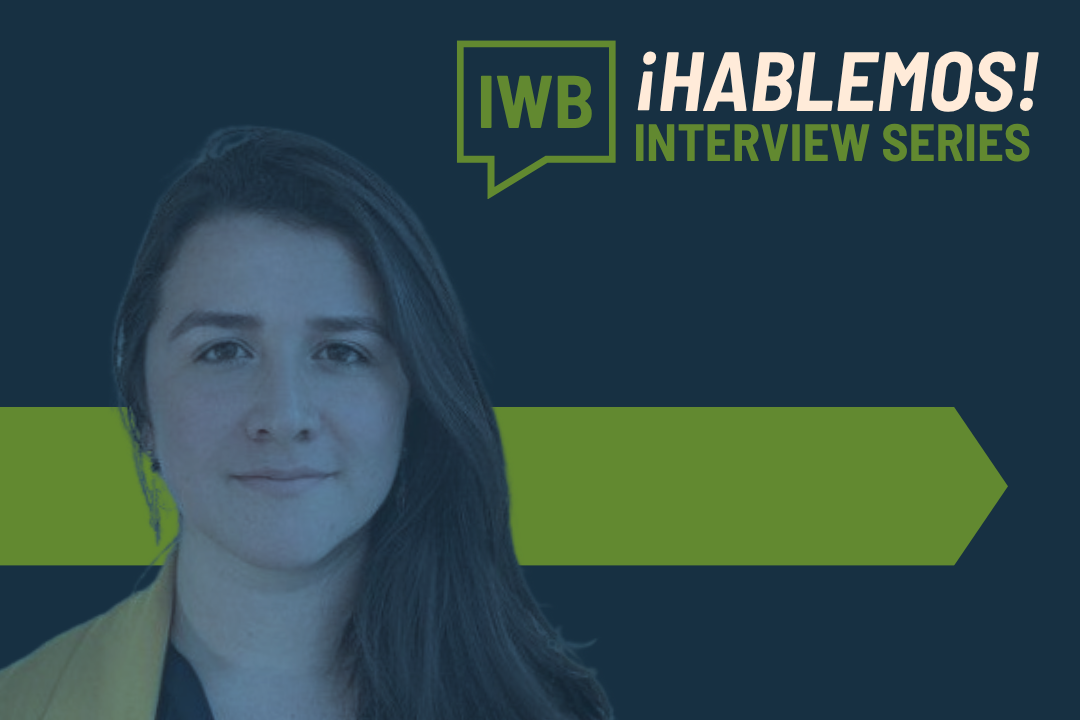
By Sophia Benavente
Dr. Lorena Avila is an Assistant Professor of Criminology at Villanova University. Her career spans Colombia and Latin America’s state-building and peacekeeping initiatives, working on projects related to comparative international criminal justice, human rights, and transitional justice.
Roots
Dr. Avila grew up in Colombia, where violence was not an abstract concept, but a daily reality woven into family and community life. The first in her family to attend college, she was drawn to the social sciences by fundamental questions including: Who gets labeled as criminal and violent? And, should punishment always be the default response to violence? She quickly recognized this was not a uniquely Colombian problem; it was a universal one.
From Community Work to Scholarship
After completing her undergraduate education and a master’s degree in public policy in Colombia, Dr. Avila came to the United States on a student visa to pursue her PhD. The COVID-19 pandemic arrived shortly after. During the pandemic, a federal directive framed international students as deportable risks to national security. For Dr. Avila, this, again, was not an abstract policy shift, but a lived encounter with how danger gets constructed and socially lived. This experience sharpened a series of questions that now anchor her research: What makes someone a “good” or “bad” immigrant? What definitions of “fear” and “risk” justify detention, surveillance, and bureaucratic exclusion?
Dr. Avila’s scholarship draws on criminology to inform immigration policy debates often dominated by legal and political rhetoric. Central to her work is the concept of crimmigration, which describes the growing intersection between criminal law and immigration law. Traditionally, immigration law was a civil matter, governed by administrative proceedings. Over recent decades, it has adopted the language, institutions, and logic of criminal punishment, such as detention, surveillance, exclusion, and the framing of migrants through the lens of danger and risk.
Crimmigration matters beyond the mechanics of law enforcement. It reveals how societies decide who belongs. It constructs a theory of social membership, which determines whose mobility should be controlled and who is considered a threat. At the same time, it exposes a significant asymmetry: criminal law comes with robust due process protections, while immigration proceedings do not. For example, people in immigration court have no right to an attorney, and if they can’t afford one, many experience the precarious protections of immigration proceedings as punishment.
Recent Work and New Publications
Dr. Avila’s recent article, The Mark of a Criminal Record in U.S. Immigration Bond Hearings builds on earlier research conducted with the Collaborative, An Expensive Pass to Freedom: Bond Amount Trajectories in Immigration Court. Together, this work examines how Latino immigrants are treated in what are ostensibly meant to be neutral, standardized legal proceedings.
Using the framework of racial projects—a concept from social legal scholarship describing how institutions, policies, and everyday practices organize and produce racial meaning—Dr. Avila argues that bond hearings are not merely technical decisions. They are spaces where ideas of deservingness and danger are evaluated, and where race operates structurally, rather than through individual prejudice.
Her findings show that Latino immigrants face a higher probability of remaining in detention via bond denials even without a criminal record, compared to non-Latino individuals with one. When a criminal record does exist, it functions as confirmation of a pre-existing suspicion that is rooted in longstanding stereotypes about Latinidad, crime, and illegality. The lack of legal representation can compound this and signal economic precarity, which is used to reinforce the stereotype of a “bad immigrant.”
Dr. Avila is careful to note that individual judges are not the root of the problem. Rather, their decisions are anchored in organizational dynamics, such as backlogs, institutional pressures, and structural frameworks, among other systematic issues that converge to frame Latino immigrants as risks requiring detention.
For Dr. Avila, the goal of research goes beyond process to identifying the institutional mechanisms driving harm and then, partnering with advocates who can use that evidence to push for change. Her research questions grow directly from community engagement. When she first experienced what it meant to become a “deportable subject,” her instinct was to seek out others navigating the same situation. From there, she found those for whom the stakes were even higher. She began volunteering with a bail fund that evolved into an immigrant bond fund, supporting families facing bond amounts that could reach $10,000. Her volunteer service brought her directly to the questions her scholarship addresses.
Her mixed-methods approach reflects this commitment to community change by bringing together quantitative analysis of court data that reveals inequalities in official proceedings with her qualitative and ethnographic work that humanizes the experiences of those who are often represented by statistics. This approach allows her to reach broader audiences.
Serving as a Policy Fellow with the Collaborative
Dr. Avila was one of the Collaborative’s inaugural policy fellows (2024-2025) and speaks warmly about what this community of scholars has meant to her work. Beyond practical support, such as refining language, making scholarship more accessible, and navigating public-facing communication, the Collaborative has provided something harder for her to quantify: a sense of safety.
At moments when she questioned whether to speak out on certain topics or considered shifting her research agenda, Dr. Avila notes that the Collaborative offered reassurance and community. It helped her see interdisciplinary, publicly engaged work as a strength and gave her confidence to bring her scholarship to broader audiences.
Dr. Avila thinks immigration is one of the most widely discussed issues in public life and one of the policy areas where people are least informed. She says that everyone has opinions, however, far fewer engage with what the data actually show. Dr. Avila wants people to understand that immigration systems are not abstract policy debates, but rather decisions with profound implications for human dignity, mobility, and self-determination.
What’s Next
Dr. Avila continues to expand her research agenda in several directions. Working with her colleague Dr. Sarah Lageson, she is currently exploring the legal and ethical confusion surrounding expungement and immigration law, where even when records have been legally erased, they still carry weight in immigration proceedings, even when people are advised not to disclose them.
In a related project with Dr. Sarah Tosh, they explore the landmark 2010 Supreme Court case Padilla v. Kentucky, which established that public defenders must advise clients of the potential immigration consequences if they enter a guilty plea. Through national interviews with public defenders and immigration attorneys, she and her collaborators are mapping how – unevenly – this mandate is being implemented. She is also writing on the gender dimensions of migration governance, examining how crimmigration mechanisms affect women.
Across all this work, Dr. Avila’s research questions remain consistent: how do democracies normalize exclusion through apparently neutral procedures? How do the administrative, legal, and punitive policies blur together, and what would justice look like if extended beyond the courtroom?
Thank you for reading IWB ¡Hablemos!, an interview series that explores the multifaceted nature of immigration studies, advocacy, partnership, and more. Interested in being featured? Email us at admin@iwbcollab.org.