
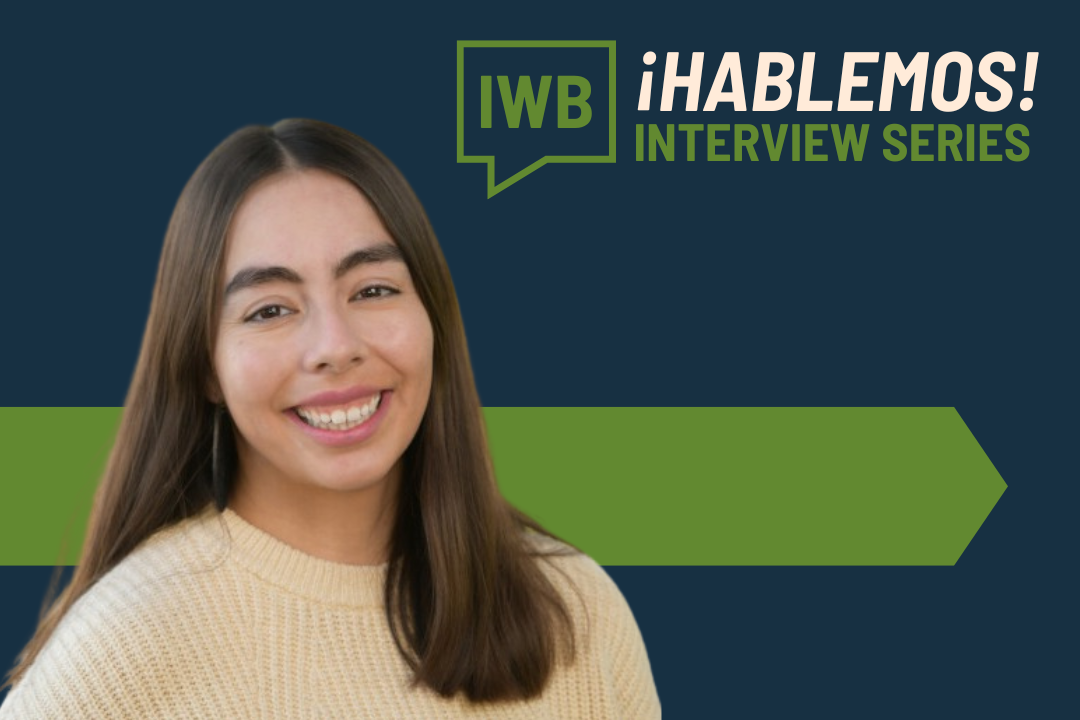
By Sophia Benavente and Thomas J. Rachko, Jr.
Dr. Blanca A. Ramirez, assistant professor of Sociology at the University of Texas, Austin, examines how immigration laws and policies shape everyday life. Her research uncovers the impacts of what scholars call “legal violence” or the harmful effects resulting from the law, especially among immigrants, revealing the broader social and health consequences of immigration enforcement. She blends rigorous sociological analysis with community-centered storytelling to illuminate both the harms and the resilience strategies that emerge in the face of immigration enforcement.
Dr. Ramirez is a Scholar Affiliate of the Im/migrant Well-Being Scholar Collaborative (“The Collaborative”). We interviewed Dr. Ramirez in August 2025 to discuss her research on im/migration and im/migrant communities, her sociological lens, “anchoring work,” and what’s next for her research.
Understanding Legal Violence in Today’s Policy Climate
Immigration policy does not happen in a vacuum. In a policy climate in which there is increasing attention to immigration, Dr. Ramirez reminds us that “Immigration laws produce real, everyday effects and harms—what scholars call legal violence.” For better or worse, she unpacks the impacts of “these laws can shorten people’s social ties, constrain their sense of agency, and shape how communities perceive the law’s legitimacy.”
Dr. Ramirez is keenly aware of the false narratives perpetuated about immigrants can influence policy: “Despite extensive research showing immigrants are less likely to commit crimes and that most deportations involve people without criminal violations, the narrative that immigrants are inherently criminal persists and is reproduced through policy and practice.” Empirical research is critical to separating fiction from fact. “Understanding these disconnects helps explain current policies and public discourse, as well as the broader social and health consequences for migrants and their families,” she shares.
A Sociological Lens, A Community-Centered Path, and Teaching “Latinx Sociology”
Dr. Ramirez views immigration policy in the United States are informed by her training as a sociologist, a unique perspective that she says, “gives me a lens to see how broader social forces shape the lives of individuals, families, and communities, including how and why they become targets of laws and constraints.” Undergirding her work is how structures like immigration law and the immigration court system, impact communities on the ground.
Now, as an assistant professor at the University of Texas, Austin, she hopes to pass down her knowledge to the next generation of young scholars. She teaches two courses: “Intro to the Study of Society” and “Latinx Sociology.” In the latter, Dr. Ramirez and her students begin by unpacking what “Latinx” is with a focus on the diversity of these communities.
The course explores how “institutional dynamics—in schools, housing markets, and immigration systems—shape well-being by structuring access to resources, exposure to surveillance, and opportunities for mobility. Recognizing the heterogeneity of Latinx experiences is crucial for designing policies that actually meet community needs.” The course is informed by her study of Latinx families in research like her article, “Anchoring work: how Latinx mixed-status families respond to interior immigration enforcement” published in the Journal of Ethnic and Migration Studies.
“Anchoring Work”: Families Provide Stability and Protect Against the Consequences of Immigration Enforcement
So, what is “anchoring work”?
Dr. Ramirez uses the analogy of an anchor which secures a boat to the seabed keeping it in place against winds, currents, and tides to emphasize the stabilizing role mixed-status families play in supporting one another. As Dr. Ramirez explains: “Anchoring work describes the strategies mixed-status families use to stabilize their lives in the face of surveillance and deportation risk—coordinating legal support, redistributing caregiving and income, building information networks, and planning for rapid family role shifts.” Therefore, people within mixed-status immigrant families become “anchors.”
With an increase in interior immigration enforcement since the start of the second Trump administration, Dr. Ramirez “Given the current uptick in interior enforcement, we should expect families to intensify these anchoring strategies, but also to experience greater strain—financial, emotional, and logistical—as uncertainty grows and legal pathways narrow.” This “greater strain” and growing uncertainty raises concerns about the well-being of mixed status with ramifications for both immigrants and U.S. citizens alike.
“Immigration enforcement is not just about the physical removal of people. It produces wide-ranging social consequences that reshape multiple institutions—families, schools, workplaces, legal professions—both now and into the future,” Dr. Ramirez expounds. “These legal systems reverberate across society, creating long-term effects that span administrations and do not begin or end with any single policy moment.” The consequences of immigration enforcement are far-reaching.
Engaging with the Collaborative
Describing her engagement with the Collaborative, Dr. Ramirez shares, “Working with the Collaborative has been energizing: it connects scholars, trains us to translate research without jargon, and amplifies our work through collective reach.” She encourages other scholars to get involved and consider translating their research for use in policymaking.
Across a continuously shifting immigration policy landscape, Dr. Ramirez articulates how legal systems transform the lives of im/migrants. By threading the needle between the narratives embedded in law, strategies families use to cope with enforcement, and the evolving practice of immigration advocacy, her work sheds light on the intersections of research, policy, and community action grounded in lived experience.
Thank you for reading IWB ¡Hablemos!, an interview series that explores the multifaceted nature of immigration studies, advocacy, partnership, and more. Interested in being featured? Email us at admin@iwbcollab.org.