By Thomas J. Rachko, Jr. and Sophia Benavente
June 16, 2025
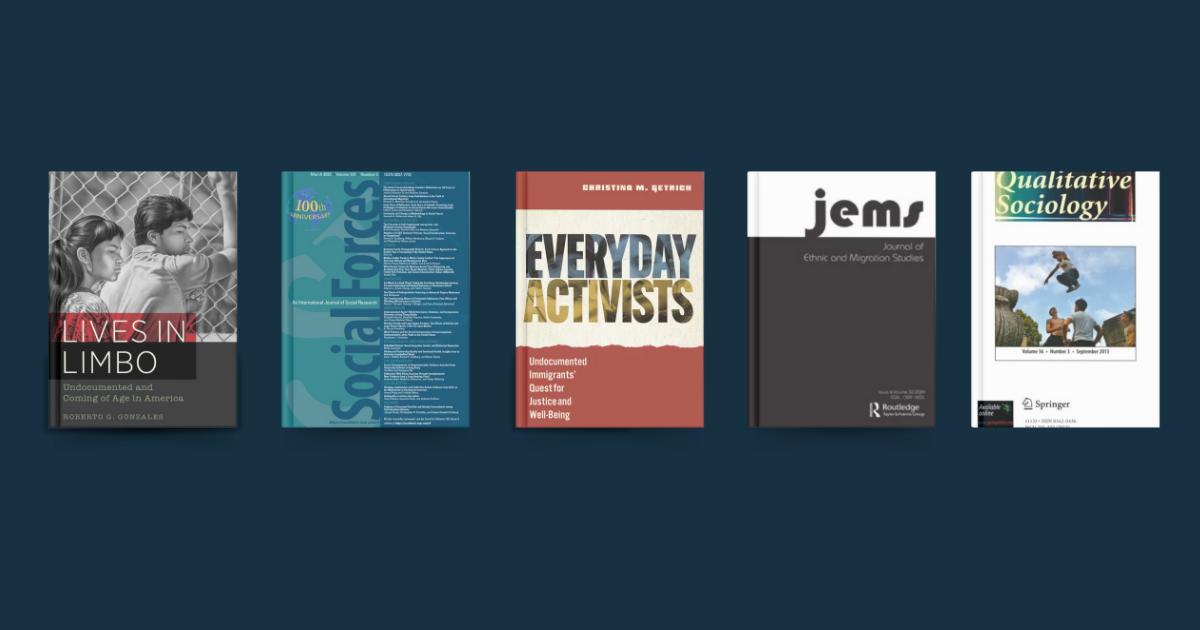
June 15th marked the 13th anniversary of the Deferred Action for Childhood Arrivals (DACA) executive order. DACA is a United States immigration policy created during the Obama administration to grant young adults who came to the country as children work authorization and protection from deportation. To commemorate this anniversary, here are five academic publications to learn more about the program and its implications for im/migrant well-being.
Lives in Limbo: Undocumented and Coming of Age in America (2015) by Roberto G. Gonzales
University of Pennsylvania Professor of Sociology and Education and Founding Director of the Penn Migration Initiative, a university-wide effort aimed at advancing and promoting interdisciplinary scholarship and intellectual exchange around issues of immigration policy and immigrant communities, Roberto Gonzales’s groundbreaking book shares findings from a 12-year ethnographic study of undocumented young adults in Los Angeles, California.
As the Collaborative Advisory Board Member Dr. Robert C. Smith emphasizes in a review of the book, Lives in Limbo is an essential read: “This necessary book documents in tragic detail how American public policies prevent hardworking children from pursuing their lives as full members of the society in which they were raised…This theoretically skillful book is one of the best examples of high-quality academic scholarship that also fully engages the policy debates of our times.”
“Undocumented Again? DACA Rescission, Emotions, and Incorporation Outcomes among Young Adults” (2023) by Elizabeth Aranda, Elizabeth Vaquera, Heide Castañeda, and Girsea Martinez Rosas, Social Forces
This article published by scholars at The George Washington University Cisneros Hispanic Leadership Institute and the Im/migrant Well-Being Research Center at the University of South Florida investigates how undocumented young adult immigrants navigated Trump-era immigration policy changes. It uses the case of those who benefited from DACA and their experiences of its rescission in 2017 to study how policy actions impact immigrant communities.
The team of researchers conducted interviews with over 50 undocumented young adult immigrants in Central Florida. The stories these young adults shared were distressing and demonstrate how immigration policies have serious implications for well-being, with 9 out of 51 people interviewed reporting they had attempted suicide, and almost half reporting they had engaged in self-harm. The findings of this research were translated into a policy brief, narrative toolkit, and discussed as part of a Congressional research briefing.
Everyday Activists: Undocumented Immigrants’ Quest for Justice and Well-Being (2025) by Christina M. Getrich
As Associate Professor and Director of Graduate Studies in the Department of Anthropology at the University of Maryland, Dr. Christina M. Getrich argues that DACA recipients fight for immigrant well-being and justice in their everyday lives in less publicly visible ways; their more private forms of action should be considered political activism.
Drawing from five years of rich ethnographic research with a diverse population of 30 DACA recipients living in the Washington, D.C. metropolitan region, Everyday Activists portrays the alternative political engagement strategies they enact in their daily lives as they leverage their unique knowledge bases and skill sets and make a meaningful impact in their communities. This book reveals how these young activists’ strategies are instructive for thinking creatively about how to show up in our everyday lives for immigrants and others who are systematically subjected to social exclusion.
Anchoring work: how Latinx mixed-status families respond to interior immigration enforcement (2023) by Blanca A. Ramirez, Journal of Ethnic and Migration Studies
When invoking the word “anchor” and immigrants, images of the threatening “anchor baby” are likely to emerge. Often portrayed as a villainous strategy where obtaining citizenship is done with the birth of a U.S.-born child, the myth of the “anchor baby” has fueled the proposals of multiple congressional bills and even state bills. In this article, Dr. Blanca Ramirez fundamentally rethinks how we use terms like the word “anchor baby” and turns the term on its head to show what it really means for immigrant families and their wellbeing.
Between 2017 and 2018, Dr. Ramirez interviewed 31 individuals from 22 Latinx mixed-status families in California with a relative previously detained and/or deported. When relatives face removal, family members, including those with DACA, mobilize to protect each other’s wellbeing and engage in “engage in ‘anchoring work’ defined as strategies these families use during a removal process to respond to the state’s removal process.”
Experiential Dual Frame of Reference: Family Consequences after DACA Youth Travel to Mexico through Advanced Parole (2021) by Emir Estrada and Alissa Ruth, Qualitative Sociology
This article, focuses on a lesser-known benefit of DACA, Advance Parole. Advance Parole is a benefit extended to DACA recipients allowing them to apply and receive permission to travel outside the United States for humanitarian, work, or educational reasons.
Many undocumented immigrants live in the United States without a pathway to live, work, and travel outside of the country. Advance Parole made this a possibility for DACA recipients. The authors, who conducted 13 in-depth interviews with Mexican-origin DACAmented youth who traveled to Mexico for educational purposes, found that Advance Parole strengthened transnational family and community ties for the DACA travelers they interviewed.